
 USA
USA Japan
Japan






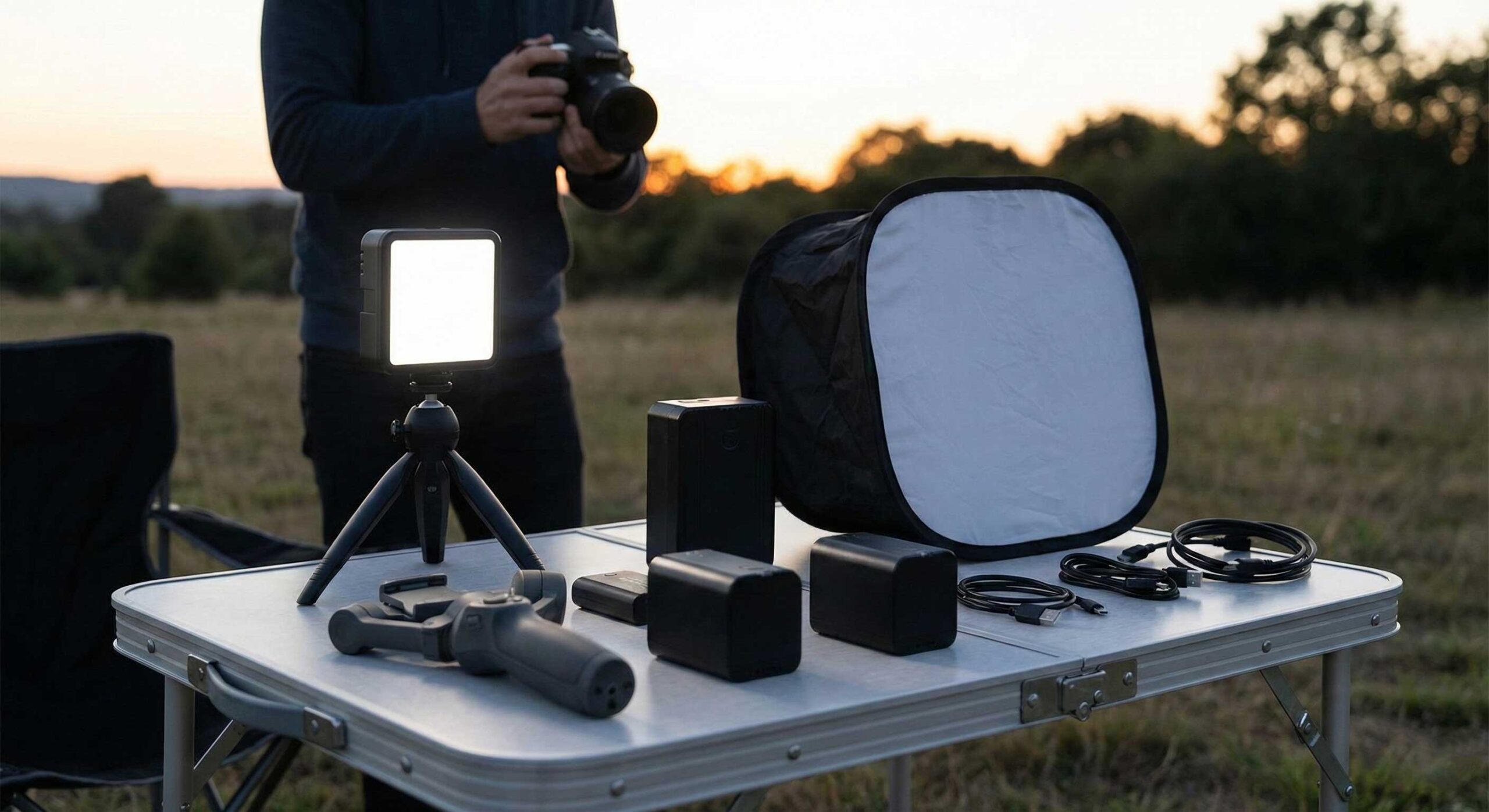
The Portable Lighting Paradox
Every content creator faces this: your studio looks amazing, but 70% of your best content ideas require leaving the house.
You can’t bring your entire rig to a coffee shop or hiking trail. But you can’t sacrifice quality for mobility either.
This guide shows what actually works for on-location content creation.
Myth #1: “Portable Lighting Can’t Match Studio Quality”
The Belief: You have to compromise quality for portability.
The Reality: Modern battery-powered LEDs match or exceed studio-quality specifications in compact formats.
What Changed
Five years ago, this myth was true. Portable lights were either bright OR color-accurate, never both. Battery technology couldn’t power high-CRI LEDs for reasonable runtime.
Today? The Culpixel Maxpower F30 Flatlight delivers CRI 96+ with 30W output in a form factor smaller than a tablet. The PJ 200 RGB gives you full RGB control plus bi-color white at 200W—battery powered.
Real-world test: We filmed identical interviews with studio lights and portable LEDs. Viewers couldn’t tell the difference. Neither could professional colorists reviewing the raw footage.
The catch: You need good portable lights, not cheap ones. A $30 ring light isn’t portable professional lighting—it’s portable amateur lighting.
Myth #2: “You Need Multiple Lights On-Location”
The Belief: Professional lighting requires three-point setups minimum.
The Reality: One strategic light plus environmental control beats multiple weak lights.
The Single-Light Strategy
Your location already has ambient light—windows, practicals, reflective surfaces. Don’t fight it. Augment it.
The setup that actually works:
- One powerful key light (Culpixel R200 BI or similar)
- Collapsible reflector for fill (5-in-1 Reflector)
- Use location’s existing light as backlight
Weight comparison:
- Three-light setup: 15-20 lbs
- Strategic single-light: 6-8 lbs
Quality difference: Minimal if you position correctly. The secret is using your single light to enhance natural light, not replace it.
Myth #3: “Battery Runtime Doesn’t Matter”
The Belief: Just bring extra batteries.
The Reality: Every battery swap creates continuity nightmares—color shifts, intensity changes, and broken concentration.
The solution: Overspec capacity. If you need 60 minutes, bring 120 minutes.
Modern lights like the Maxpower F30 claim 90 minutes at full power. Real-world use: expect 60-70 minutes. Plan accordingly.
Pro tip: USB-C charging means any 20,000mAh power bank triples your runtime.
Myth #4: “Portable Means Compromising Power”
The Belief: Battery-powered lights are too weak for professional use.
The Reality: Modern LED efficiency means 200W portable lights match 500W studio lights from five years ago.
The LED Revolution
LED technology improved dramatically. Today’s 30W LED outputs what 150W tungsten did in 2015.
Practical example: The Culpixel R300 B at 300W provides enough power for:
- Solo interviews in daylight conditions
- Product photography with diffusion
- Environmental portraits outdoors
- Multi-person setups indoors
Even compact options like the R200 BI (200W) handle 90% of mobile content needs.
When you actually need more power: Large groups (4+ people), competing with harsh sunlight, or lighting large spaces. For everything else, 200-300W is plenty.
Myth #5: “You Can’t Control Color Temperature On-Location”
The Belief: Portable lights are fixed temperature, limiting creative options.
The Reality: Modern portable bi-color LEDs adjust from 3200K to 5600K+ instantly.
Why This Matters More Than You Think
Location lighting changes constantly:
- Morning shoot: 5600K+ (cool daylight)
- Afternoon indoors: 4000K (mixed lighting)
- Evening near windows: 3200K (warm sunset)
Fixed-temperature portable lights force you to choose: match morning light OR evening light, not both.
Bi-color portable lights like the R200 BI adapt to any situation. Filming all day? Your light temperature changes with ambient conditions, maintaining consistent white balance.
Real scenario: We filmed a “day in the life” video across 8 hours. Single bi-color light adjusted from 5600K (morning) to 3800K (evening) matching natural light transitions. Result: seamless footage without color correction.
What Actually Belongs in Your Mobile Kit
After testing 40+ configurations with professional creators, here’s what works:
The Minimalist Setup ($200-350)
For: Solo creators, talking heads, simple product demos
- Culpixel Maxpower F30 Flatlight ($32.99) – Compact, powerful, RGB capable
- 5-in-1 Collapsible Reflector ($19.99) – Fill light solution
- Compact light stand (tripod-mountable) ($40-80)
- Diffusion material (shower curtain or dedicated fabric) ($15-30)
Total weight: 4-6 lbs
Setup time: 3-5 minutes
Battery life: 90+ minutes
The Professional Mobile Setup ($500-800)
For: Interviews, commercial work, multi-subject content
- Culpixel R300 B ($279) – Primary key light
- Culpixel R200 BI ($149) – Fill/accent
- PJ 200 RGB ($99.99) – Creative background accent
- Octagonal Softbox 65CM ($89-99) – Diffusion
- Two compact stands ($120-160)
Total weight: 12-15 lbs
Setup time: 8-12 minutes
Battery life: 60-90 minutes (dual battery system)
The Creator’s Backpack Setup ($350-500)
For: Vloggers, travel content, run-and-gun filming
- Culpixel R200 BI ($149) – Main light
- Maxpower F30 ($32.99) – Fill/on-camera
- 5-in-1 Reflector ($19.99)
- Small articulating arm/clamp mount ($30-50)
- Compact backpack with padded compartments ($80-120)
Total weight: 6-8 lbs
Setup time: 2-4 minutes
Battery life: 90-120 minutes
The Three Rules of Portable Lighting
After 200+ on-location shoots, these principles never fail:
Rule 1: Weight Is Your Enemy
Every ounce matters when you’re walking to locations. If you won’t carry it comfortably for 20 minutes, leave it home.
The test: Load your bag. Walk around your block. Still comfortable? Good. Shoulders hurting? Remove something.
Rule 2: Setup Speed Determines Shot Count
Complicated setups mean fewer locations, fewer angles, less content. Simple setups mean more shots, more variety, better content.
Target setup time: Under 5 minutes from bag to filming. Over 10 minutes means you’ll skip setups when opportunities arise.
Rule 3: Reliability Beats Features
On-location, you can’t troubleshoot. Dead batteries, connection failures, or inconsistent output kill shoots.
Invest in reliability: Quality portable lights cost more but never fail mid-shoot. Budget lights are gambles—sometimes they work, sometimes they don’t.
Common Portable Lighting Mistakes
Mistake: Bringing too much backup gear “just in case”
Fix: Bring one proven setup, not three untested ones
Mistake: Ignoring weather resistance
Fix: Even water-resistant isn’t enough. Bring plastic bags and rain covers
Mistake: Forgetting gaffer tape and clamps
Fix: Your light stand will fall over. Your reflector will blow away. Bring securing supplies
Mistake: No shot list = wasted battery life
Fix: Plan your shots. Don’t waste power on test footage
Mistake: Matching every light source at location
Fix: Impossible and unnecessary. Match your key light to dominant ambient source, let others fall naturally
Location-Specific Strategies
Coffee Shops / Indoor Public Spaces
Challenge: Mixed lighting (windows + fluorescents), no control over environment
Solution: Position near window, use portable bi-color to match window temp, let fluorescents fall into background
Gear: One R200 BI + reflector
Outdoor Daylight
Challenge: Competing with sun, harsh shadows
Solution: Position subject in open shade, use portable light as fill to reduce contrast ratio
Gear: One R300 B with diffusion, reflector for additional fill
Indoor Low-Light Venues
Challenge: Not enough ambient light, can’t overpower practicals
Solution: Embrace low light aesthetic, use portable as subtle key maintaining mood
Gear: R200 BI at 30-50% power + warm temperature (3200K)
Vehicle Interiors
Challenge: Extremely tight space, limited positioning options
Solution: Compact light mounted to sun visor or windshield, bounced off ceiling
Gear: Maxpower F30 with flexible mount
The Bottom Line
Portable lighting isn’t about recreating your studio on-location. It’s about enhancing what’s already there.
Stop fighting ambient light. Start working with it.
Stop carrying everything. Start carrying the right things.
Stop compromising quality. Start investing in quality portable gear.
Modern technology makes professional portable lighting not just possible, but practical. The only question is whether you’re willing to invest in proper equipment rather than cheap alternatives that fail when you need them most.
Your studio setup took time and money to perfect. Your portable setup deserves the same investment.
The creators getting the best on-location content aren’t the ones with the most gear. They’re the ones with the right gear, mastered through practice.
Quick Decision Matrix:
Budget under $200: Maxpower F30 + 5-in-1 Reflector
Budget $200-400: R200 BI + reflector + compact stand
Budget $400-600: R300 B + R200 BI setup
Budget $600+: Full professional mobile kit with PJ 200 RGB for creative options
Get out there. Test your setup. Adjust based on what actually works for YOUR content and YOUR locations.
The best portable lighting setup is the one you’ll actually bring with you.