
 USA
USA Japan
Japan









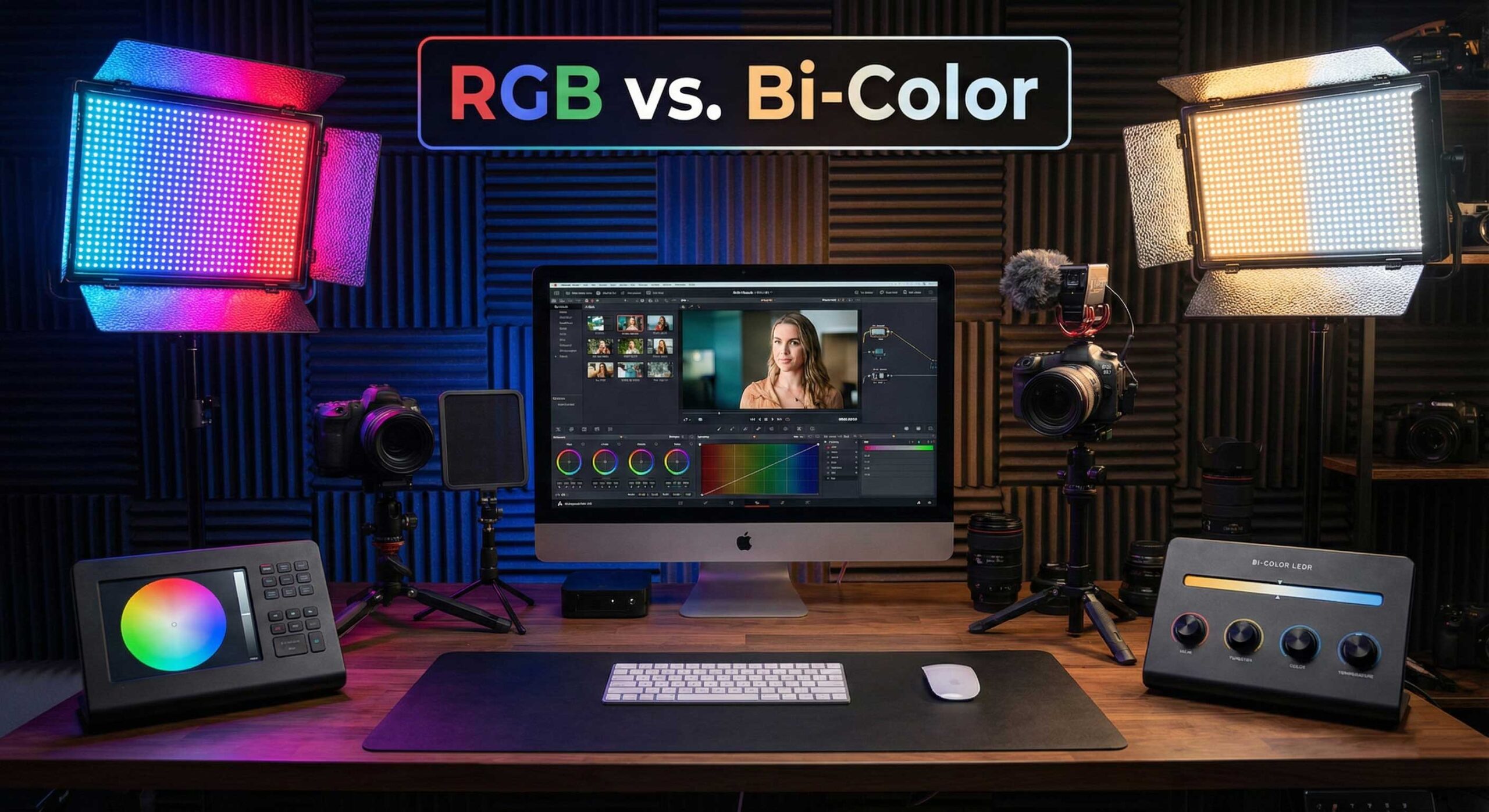
Look, I get it. You’re scrolling through lighting options and see those gorgeous rainbow RGB panels next to the “boring” bi-color lights, and you’re thinking “Obviously I want the one with a million colors, right?”
Not so fast.
I’ve spent the last year talking to hundreds of creators who bought RGB lights thinking they’d unlock creative superpowers, only to realize they’re using them at 5600K white… 95% of the time. Meanwhile, others swear by bi-color simplicity and never look back.
So which one do you actually need? Let’s cut through the marketing hype and figure this out based on what you’re really going to use.
The “Cool Factor” vs. Reality Check
You see your favorite YouTuber with sick purple and blue background lighting. You think “I need RGB lights!”
Three months later, you’re filming your 47th video with the lights set to plain white because neon pink doesn’t work for finance tutorials.
The disconnect between what looks cool in other people’s content and what actually works for YOUR content is massive.
What RGB Lights Actually Do (That Bi-Color Lights Don’t)
RGB lights can produce virtually any color by mixing red, green, and blue LEDs. Want purple? Mix red and blue. Want yellow? Mix red and green. Want that cyberpunk teal? You got it.
But here’s the catch most people don’t realize: when you use RGB lights to make “white” light, you’re getting significantly less light output AND worse color accuracy than dedicated bi-color lights.
Think of it like this: RGB lights are like a smartphone camera. Sure, they can do everything, but they’re not exceptional at any one thing. Bi-color lights are like a professional camera lens – they do one thing (white light from warm to cool) but they do it REALLY well.
The Honest Truth About Your Content Type
If You Make These Types of Content, Get Bi-Color
Corporate Videos / Business Content
Nobody’s watching your quarterly review presentation thinking “you know what this needs? More magenta.” Your clients want clean, professional white light that makes you look trustworthy. Bi-color gives you perfect white light at any temperature you need.
Beauty / Makeup Tutorials
This one’s non-negotiable. Showing accurate product colors under RGB white light is like trying to show someone a painting through sunglasses. The colors will be off. Makeup brands will actually get mad at you if their $45 lipstick looks completely different on camera because of poor lighting CRI.
Educational Content / Online Courses
Students are trying to learn, not be distracted by your creative lighting choices. Clean, consistent white light keeps focus where it should be – on the content.
Product Reviews
Same deal as beauty content. That new smartphone looks blue under RGB white light? Congrats, your comment section is now full of people asking “why does the phone look blue?”
Professional Interviews / Documentaries
Serious content demands serious lighting. RGB lights make you look like you’re filming in a gaming setup, not a professional production.
If You Make These Types of Content, RGB Might Actually Make Sense
Gaming Content / Streaming
Okay, THIS is where RGB shines (pun intended). Your audience expects the RGB aesthetic. Purple and cyan backgrounds are part of the culture. Go wild.
Music Videos / Creative Projects
You’re literally trying to create mood and vibe. RGB gives you that flexibility without buying colored gels or multiple dedicated colored lights.
Party / Event Coverage
Capturing nightlife, concerts, events where colored lighting is part of the atmosphere? RGB lets you match or create that energy.
Short-Form Content (TikTok/Reels)
When you’ve got 15 seconds to grab attention, that color-shifting background transition can actually help. Plus, trends on these platforms lean heavily into RGB aesthetics.
Tech/Gadget Channels with Strong Brand Colors
If your whole brand is “that channel with the orange background,” an RGB light locked to your signature color makes sense.
The Uncomfortable Middle Ground
Sure, you can get both if budget allows. Bi-color for main lighting, RGB panel for background accents – that’s actually the pro move.
But choosing ONE type? Choose based on your PRIMARY content, not occasional creative videos you might make “someday.”
Too many creators buy expensive RGB for their “creative vision,” then struggle with poor color accuracy on daily content.
The Technical Stuff Nobody Explains Properly
Color Rendering Index (CRI)
Bi-color lights typically hit CRI 95-97. This means they render colors 95-97% as accurately as natural sunlight.
RGB lights making white? Usually CRI 80-85. Some claim 90+, but in real-world use, you’re getting noticeably worse color accuracy. Your skin tones will look slightly off. Products won’t show true colors. It’s subtle enough that viewers might not consciously notice, but they’ll FEEL something’s wrong.
Light Output
Here’s the dirty secret: An RGB panel rated at “200W” produces maybe 120-140W of actual usable white light. You’re paying for three separate LED arrays (red, green, blue) that have to work together to make white, and you lose efficiency in the process.
A 200W bi-color light? You get the full 200W of white light output. Because it’s using dedicated white LEDs designed for exactly that purpose.
Color Temperature Range
Most bi-color lights: 3200K to 5600K with precise control
Most RGB lights in white mode: 2700K to 6500K but with less precision and consistency
The irony? RGB lights technically have a wider temperature range, but the quality at the extremes is worse than bi-color lights.
Real Creator Scenarios
Sarah – Fitness Coach: Bought RGB for “premium” look. Three months later, only uses warm white. Wishes she’d invested in better bi-color output.
Marcus – Gaming Streamer: Perfect RGB use case. Purple/blue backgrounds match his brand. Face lit with bi-color for accuracy. Smart combo.
Jennifer – Real Estate Agent: Almost bought RGB. Glad she went bi-color. Property tours need accurate colors – marble countertops must look like marble, not bluish stone.
Alex – Comedy Creator: Loves RGB. Different sketches get different moods. Lighting becomes storytelling. The rare 5% where RGB makes perfect sense.
The Decision Framework Nobody Gives You
Ask yourself these three questions:
Question 1: What percentage of my content actually NEEDS colored light?
If the answer is under 20%, you don’t need RGB lights. Get bi-color for your main lighting. If you occasionally want colored backgrounds, buy a cheap $30 RGB panel just for that purpose.
Question 2: Would colored lighting distract from my message or enhance it?
Be honest here. If you’re teaching people how to do their taxes, purple lighting isn’t enhancing anything. If you’re reviewing the latest RGB gaming keyboard? Yeah, matching lighting actually fits.
Question 3: Is color accuracy critical for my content?
Beauty, fashion, product reviews, food, art – all YES. Gaming, music, entertainment, vlogs – you can probably get away with slightly worse CRI.
What I’d Buy If I Were Starting Today
Business/Professional Creator: 85% budget on bi-color (main lights), 15% on one RGB panel (optional background accent)
Gaming/Entertainment Creator: 40% on bi-color (face lighting), 60% on RGB (background aesthetic)
Mixed Content Creator: Get bi-color first. They work for everything. Add RGB later when budget allows. You can make creative content with bi-color, but you can’t make professional business content with RGB.
The Bottom Line Nobody Wants to Hear
RGB lights aren’t “better” than bi-color lights. They’re different tools for different jobs.
RGB lights are like SUVs – handle any terrain, but not exceptional at any specific thing. Bi-color lights are like sports cars – do one thing exceptionally well.
For 80% of content creators, bi-color lights give better results. Period.
For the other 20%? RGB opens creative doors that bi-color can’t.
Figure out which group you’re in BEFORE you spend money.
Quick Decision Cheat Sheet
Get Bi-Color If:
- Color accuracy matters for your content
- You film people’s faces regularly
- Your content is educational, professional, or product-focused
- You value light quality over creative flexibility
- You want the brightest output for your budget
Get RGB If:
- Gaming/streaming is your primary content
- Creative color is part of your brand identity
- You make music videos, short-form content, or artistic projects
- You’re okay with slightly lower CRI for the color flexibility
- Your audience expects the RGB aesthetic
Get Both If:
- You have the budget for a hybrid setup
- Your content genuinely spans both categories regularly
- You’re building a professional studio that handles diverse clients
That’s it. No complicated specs sheets. No marketing nonsense. Just honest advice based on what actually works in the real world.
Choose wisely, light appropriately, and remember: the best lighting is the lighting that makes YOUR specific content look better, not the lighting that looks cool in someone else’s video.