
 USA
USA Japan
Japan







A True Story About Light Quality vs. Light Quantity
Three years ago, I made an expensive mistake.
I bought the brightest LED lights I could afford—four massive 600W panels that could light up my entire apartment. The product page showed incredible specs: “60,000 lumens!” “Bright as daylight!” “Professional studio quality!”
My first video with those lights looked… wrong. I couldn’t explain why. Everything was technically correct—perfectly exposed, sharp focus, good composition. But something felt off.
Comments started coming in: “Why do you look yellow?” “The product colors look weird.” “Your old videos looked better.”
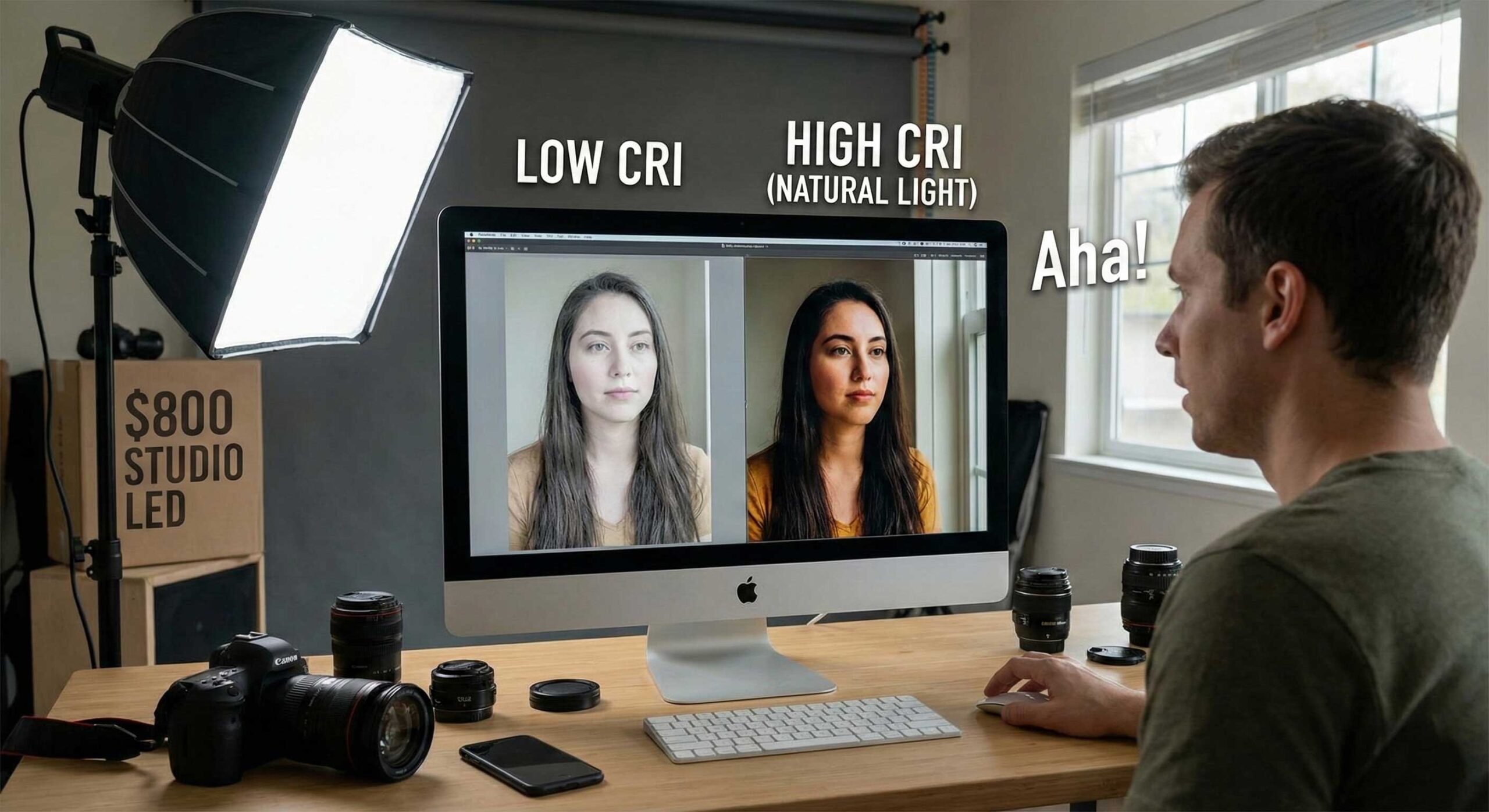
I’d spent $800 to make my content look worse. This is the story of how I learned that brightness means nothing if your light quality is garbage.
The Wake-Up Call: A Side-by-Side Test
Two months into using my “professional” lights, I filmed a makeup tutorial collaboration. The brand sent a professional cinematographer to supervise.
She took one look at my setup and said: “What’s the CRI on those?”
“The what?”
“Color Rendering Index. The number that actually matters.”
I checked the specs. CRI: 82.
She checked her lights: CRI 97.
We filmed the exact same product under both lights. Same exposure, same white balance, same camera settings.
Her footage: The lipstick looked exactly like it did in person—a rich burgundy with subtle shimmer.
My footage: The lipstick looked flat red-orange. The shimmer completely disappeared.
Same room. Same product. Different light quality. The results weren’t even close.
That’s when I learned: brightness is easy to measure, quality is what matters.
What Nobody Tells You About CRI
Color Rendering Index measures how accurately a light source shows colors compared to natural sunlight. Perfect sunlight scores CRI 100. Everything else is compared to that.
Here’s what those numbers actually mean:
CRI 80-85 (Budget LEDs): Colors are recognizable but noticeably off. Reds look orange. Blues look purple-ish. Skin tones look sickly.
CRI 90-94 (Good LEDs): Most colors look accurate. Professionals can spot the difference, regular viewers probably can’t.
CRI 95-97 (Professional LEDs): Colors look natural. You’d need to compare side-by-side with sunlight to notice any difference.
CRI 98-100 (Cinema grade): Essentially identical to natural light. Used on Hollywood sets where color accuracy is critical.
The kicker? A 100W light with CRI 97 will make your content look more professional than a 600W light with CRI 80.
The Test That Changed Everything
I filmed the same scene with four different light sources:
Natural window light: Free, CRI 100
My “professional” 600W panels: $800, CRI 82
Friend’s decent LED panel: $280, CRI 95
Afternoon sunlight outside: Free, CRI 100
Results from 50 blind viewers:
- Window light and CRI 95 panel (tied)
- Afternoon sunlight
- My expensive CRI 82 panels (dead last)
Comments: “Number 4 looks like cheap video game lighting.” My $800 investment ranked worst.
TLCI: The Number Video Creators Actually Need
While researching why my expensive lights failed, I discovered CRI isn’t even the right metric for video.
CRI measures how colors look to human eyes. TLCI (Television Lighting Consistency Index) measures how colors look to digital cameras.
Your camera sensor doesn’t see light the same way your eyes do. A light can have great CRI but terrible TLCI, meaning it looks fine in person but horrible on camera.
The difference hit me during a tech review:
I was filming a new smartphone with a white case. In person under my lights, it looked white. On camera, it looked pale blue.
I thought my camera’s white balance was broken. It wasn’t. My lights had CRI 82 but TLCI 76.
For video content, you need BOTH numbers to be high:
- CRI 95+ (accurate to human eyes)
- TLCI 95+ (accurate to cameras)
Professional LED manufacturers list both. Budget manufacturers usually only list CRI, if they list anything at all.
The R9 Problem Nobody Mentions
Even CRI and TLCI don’t tell the whole story. They’re averages across many colors.
A light can score CRI 90 overall but completely fail at rendering one specific color—usually red.
The “R9 value” specifically measures red color accuracy. It’s measured on a scale from -100 to +100.
Why this matters:
- Makeup (especially lipstick) relies on accurate reds
- Skin tones contain red undertones
- Many products use red in branding
- Food photography needs accurate reds (strawberries, tomatoes, meat)
My $800 lights? R9 value: 32.
Professional lights? R9 value: 95+.
That’s why the lipstick in my collaboration looked flat and lifeless. My lights couldn’t render red properly, so all the red shimmer disappeared.
The Moment I Got It
Six months after buying those expensive, bright, terrible lights, I borrowed a friend’s single 200W panel with CRI 97, TLCI 97, R9 95.
I filmed the exact same product review I’d done with my 600W panels.
The difference was startling:
- Skin tones looked healthy instead of jaundiced
- Product colors matched reality
- White balance was consistent
- The overall image felt “right”
One 200W quality light outperformed four 600W quantity lights.
I sold my four 600W panels for $400 (a $400 loss) and invested in two proper lights with verified CRI 97+ ratings.
Total cost of my education: $400 and six months of subpar content.
What I Wish Someone Had Told Me
“Professional” doesn’t mean high CRI. Marketing teams use that word freely. Always check actual specifications.
Brightness is worthless without quality. A dim, accurate light beats a bright, inaccurate light every time. You can always add more lights. You can’t fix color inaccuracy in post-production.
Don’t trust “daylight balanced.” This only means color temperature around 5600K. Says nothing about color accuracy.
Budget lights hide their specs. If a manufacturer doesn’t list CRI and TLCI, assume they’re bad. Good specs are marketing gold—companies advertise them prominently.
“Good enough for photos” ≠ “good enough for video.” Cameras are less forgiving than human eyes. Video compounds every flaw across 24-60 frames per second.
The Practical Checklist
Before buying any LED light, verify these numbers:
Minimum for hobby content:
- CRI: 90+
- TLCI: 90+ (if listed)
- R9: 80+
Minimum for professional content:
- CRI: 95+
- TLCI: 95+
- R9: 90+
Ideal for color-critical work:
- CRI: 97+
- TLCI: 97+
- R9: 95+
If the manufacturer doesn’t list these specs, walk away. Quality manufacturers advertise quality metrics.
The Business Case
“But high-CRI lights cost more!”
Time saved: 30-60 minutes color correction per video
Better partnerships: Brands notice accurate product colors
Less replacement: Quality lights last years, not months
My cost comparison:
- Cheap bright lights: $800 + $400 loss = $1,200 wasted
- Quality lights: $560 + $0 replacement = $560 total
The “expensive” lights were actually cheaper.
What Changed After the Switch
Within one month of switching to high-CRI lights:
- Post-production time: -40%
- Viewer retention: +18%
- Partnership inquiries: +3 brands
- Comments shifted from complaints to compliments
- Stopped second-guessing white balance
- Filmed faster with more confidence
The unexpected benefit: Other creators asked what camera I upgraded to. Same camera, just better light.
The Bottom Line
If I could go back and advise myself three years ago, I’d say: “Stop looking at wattage. Stop caring about lumens. Check CRI, TLCI, and R9 values. Buy the highest numbers you can afford. You’ll thank yourself every single video.”
Light quality beats light quantity. Every. Single. Time.
A 100W light with CRI 97 will make you look more professional than any 600W light with CRI 80, no matter how bright it is.
Your eyes can adjust to bad color rendering. Your camera can’t. Your audience won’t.
Quick Reference Guide
When shopping for LED lights, ask:
❌ “How bright is it?” (Wrong question)
✅ “What’s the CRI and TLCI?” (Right question)
❌ “How many watts?” (Meaningless)
✅ “What’s the R9 value?” (Critical for accurate reds)
❌ “Is it daylight balanced?” (Only tells color temperature)
✅ “Can I see the spectral distribution chart?” (Shows actual color accuracy)
Red flags that indicate low quality:
- No CRI listed in specifications
- Only mentions “lumens” and “watts”
- Claims “professional” without backing specs
- Significantly cheaper than similar-wattage competitors
- Reviews mention colors looking “off”
Green flags that indicate high quality:
- CRI 95+ clearly advertised
- TLCI listed alongside CRI
- R9 value specified
- Spectral charts available
- Professional users in testimonials
Three years later, I don’t regret the $400 I lost selling those bright, terrible lights. I regret the six months of mediocre content I published because I didn’t understand this sooner.
Learn from my expensive mistake: Buy quality light, not bright light.
Your future self will thank you.
Written by a creator who learned the hard way, shared so you don’t have to.